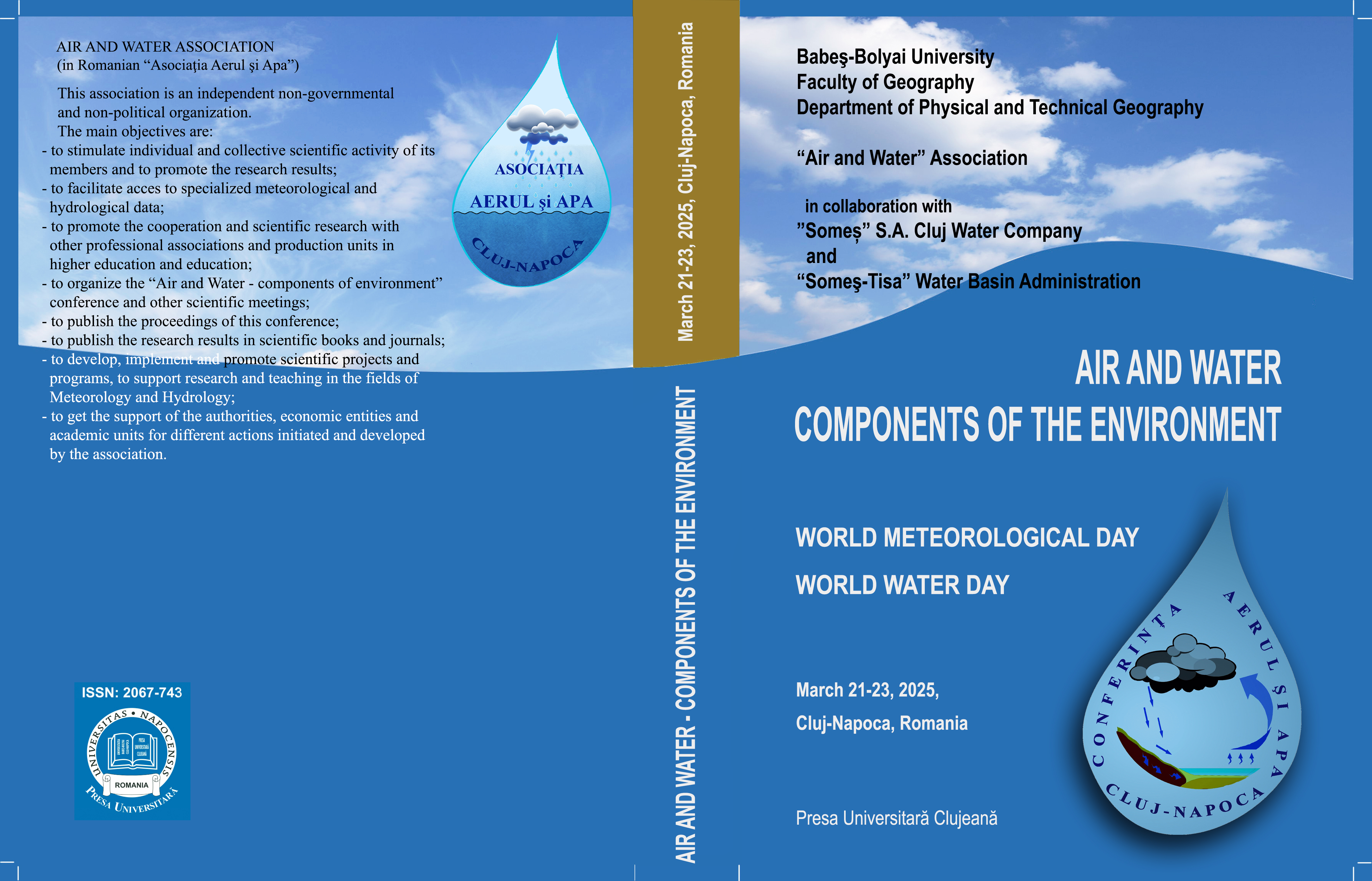
2025 Edition Photos
First pages Full text
Contents Full text
Csaba HORVÁTH – World Water Day – March 22, 2025
pp: VIII-IX | Full text
Traian TUDOSE – World Meteorological Day – March 23, 2025
pp: X-XII | Full text
I. Climatic and Hydrological Hazards
Răzvan BĂTINAŞ, Ionel Sorin RÎNDAȘU-BEURAN, Viorel CHENDEŞ Bogdan Gabriel PITICARI, Cristiana Georgiana ZANFIR, Ionela DĂNILĂ (Vâzdoagă), Silvia RĂVDAN (Oprea) , Simion NACU, Alexandru SÎNTU-LĂSAT
Spatio-Temporal Analysis of Floods in Galați County, Romania, betwen 2013-2024
pp: 1-15 | DOI: 10.24193/AWC2025_01 | Full text
Exceptional flood events can occur under specific circumstances, like heavy rainfalls, dam breach, uncontrolled spills form reservoirs, rapid snow or glacial melt. Romania has experience in the last decade several episodes of extreme floods with important loss of life and considerable infrastructure damages. Based on the information collected and processed by Romanian Waters National Administration (RWNA) on flood database reported in Galați County, Romania, during the period 2013-2024, we have recorded 34 flood events due to river overflows and slope runoff, of which three events are labeled as historical: 2013, 2016 and 2024. The 2013 event had nine fatalities, while the 2024 event had seven victims. The three events were described by historical levels and discharge values on the Suhu and Geru streams, tributaries of Siret River. The largest event was recorded in 2024, after a prolonged drought, with extreme rainfalls amount that exceeded in some places more than 150 mm. On the other hand, in three years 2014, 2015 and 2017, no flood damage was reported in Galați County. The highest frequency flood events were recorded in the communes of Băneasa and Drăguşeni, with 13 cases, Valea Mărului with 12 events and in Smulţi commune with 9 events. This paper makes an analysis of latest flood events in Galați County with a special comparison assessment between the three historic mentioned events. Thus, we have focus on their genesis, rainfall amount distribution, floods feature according to the defense levels, flood frequency and physical damage recorded and the affected localities.
Narcisa MILIAN, Maria-Luiza PIEPTENARU, Paul CIOBAN, Dorian-Udo RECKERTH
Variations of Nivometeorological Parameters During the Winter Season 2023-2024
pp: 17-26 | DOI: 10.24193/AWC2025_02 | Full text
The paper presents and analyze snow and meteorological parameters of the 2023-2024 winter, measured at the meteorological stations with nivological program (Predeal, Sinaia 1500, Parâng, Semenic, Vlădeasa, Ceahlău-Toaca, Iezer, Călimani, Țarcu, Bâlea-Lac, Vârful-Omu), as well as the estimated avalanche risk for each monitored massif. The aim of that study is to highlight the importance of avalanche monitoring and snow studies in the mountainous areas affected by avalanches, in order to provide a daily estimation of avalanche risk. The data used are daily meteorological and nivological observations from the mountain meteorological stations with nivological program. In order to improve avalanche risk forecasting, both observations at the snow surface and inside the snowpack are needed, together with a detailed weather forecast.
Maria-Luiza PIEPTENARU, Raul-Marian STOICA, Szilárd HALADA, Narcisa MILIAN
Temperature Records in the Summer of 2024 in Transylvania.
pp: 17-26 | DOI: 10.24193/AWC2025_03 | Full text
The summer of 2024 was marked by extreme temperatures, including maximum and minimum temperatures records and several heat waves. The highest maximum temperatures were usually recorded at the Alba-Iulia meteorological station, although other stations also observed extreme values on specific days. In June, temperatures frequently exceeded 30 degrees, there were several heat weave episodes; instability was more accentuated in the first half of the month and in the last week. Thermal discomfort was pronounced particularly in July, when maximum temperatures constantly exceeded 31-34 degrees (up to 39 degrees). Many tropical nights were recorded, with minimum temperatures remaining above 20 degrees, setting new records for this period. In August, heat waves continued, but temperatures slightly decreased, remaining well above the multiannual average. Episodes of atmospheric instability were less frequent than the previous months, though significant precipitation was recorded on certain days.
II. Air and Water Environment Monitoring
Doruța CIURLĂU, Mihaela BORCAN, Isabelle COICIU, Rodica Georgiana CIOBOATĂ, Aurel DUMITRAȘCU
Spatiotemporal Analysis of Cold-Season Minimum Runoff in the Argeș-Vedea River Basin
pp: 27-39 | DOI: 10.24193/AWC2025_04 | Full text
Taking into account the different causes that generate the minimum flow during the warm season (May-October) and the cold season (November-April), as well as the fact that the use of minimum flow values in design activities is related to seasonal consumptions specific to each period, the study of minimum flows is generally carried out separately. In this paper we analyzed the minimum flow during the cold season (November-April) within the Argeș - Vedea hydrographic area, by utilizing the average minimum daily flows from the hydrometric stations considered characteristic, for a period of at least 15 years and a maximum of 30 years, from the time interval, 1991-2020. The vulnerability assessment of the resources offered by the hydrographic network of the Argeș - Vedea hydrographic area during the cold period represents an interesting analysis objective with certain practical value. The paper carries out a detailed analysis of the runoff regime in the Argeș – Vedea hydrographic area in order to identify the causes (natural: climate change, winter phenomena or anthropogenic: the influence of the complex system of hydrotechnical works with a role in quantitative management of water resources) that contribute to their occurrence and of the dry periods and characteristic years in terms of minimum runoff. To achieve the objective of the paper, in addition to the statistical processing of data series from the hydrometric stations analyzed within the Argeș – Vedea hydrographic area, GIS interpolation methods were also used. The spatial distribution of the values of the specific minimum annual and seasonal average flows is approximately similar. The values decrease with the altitude from north to south, with the highlighting of some islands in the eastern part of the hydrographic area at the confluence of the Argeș River with its main tributaries, Dâmbovița and Neajlov, and in the western part at the confluence of the Vedea and Călmățui rivers. By identifying the ʺ0ʺ values of the minimum average flows, the presence of winter phenomena was observed in too few cases. This fact leads to the conclusion that global warming is reflected in the minimum runoff on the rivers.
Andrei DANILĂ, Robert STRECHE, Oana ORZA, Cristina DOBRE, George SUCIU
Intelligent System for Monitoring and Optimizing Viticultural Processes
pp: 41-50 | DOI: 10.24193/AWC2025_05 | Full text
Viticulture faces increasing challenges related to environmental sustainability and operational efficiency. To address these issues, this work presents the development of an innovative management and monitoring platform tailored for vineyard operations. The proposed platform integrates IoT technology and advanced data analysis to optimize viticultural processes. Key features include real-time tracking of machinery, such as tractors, for precise route visualization, as well as the monitoring of important parameters such as CO₂ emissions, fuel consumption, and other operational metrics. By analyzing these parameters, the platform aims to improve resource efficiency and minimize the environmental footprint of vineyard activities. Additionally, the platform incorporates IoT-enabled climatic monitoring systems to gather data on temperature, humidity, and other weather-related variables, ensuring better decision-making for vineyard management. By merging machinery telemetry with environmental monitoring, the platform provides an advanced solution to improve sustainability in viticulture. This approach not only contributes to reducing greenhouse gas emissions but also aligns with modern practices for precision agriculture. Through this initiative, we aim to demonstrate how technology can empower vineyards to achieve higher efficiency while promoting eco-friendly practices.
Mert SABANCIOGLU, Mustafa DEMIRCI, Yunus Ziya KAYA
Estimation of Beginning Points of Cross-Shore Sandbars Using Artificial Neural Network
pp: 51-64 | DOI: 10.24193/AWC2025_06 | Full text
Sediment transport is critical for the design of coastal structures. In this paper, beginning points of cross-shore sandbars predicted using artificial neural network (ANN), multi-linear regression (MLR), and Quadratic-Multivariable Regression (Q-MR). The dataset was obtained as a result of a physical model . In experiments, 3 different bed slopes and 5 different grain sizes were used. Bed slope, grain size, wave period, and wave steepness were used as independent variables. The dependent variable was the beginning point of cross-shore sandbars (Xb). Mean Average Error (MAE), Mean Square Error (MSE), Root Mean Square Error (RMSE) results, and correlation and regression results were checked to compare the created models. When the results were compared, it was concluded that the ANN model gave better results than traditional statistical methods.
Lucian SFÎCĂ, Andrei BÂRLEA, Pavel ICHIM, Robert HRIȚAC
Thermal Profile of a Carpathian Cold-Air Pool: Teșnița Valley from Dorna Depression
pp: 67-80 | DOI: 10.24193/AWC2025_07 | Full text
The present paper explores the thermal environment close to Poiana Stampei weather station using hourly data, collected during one full calendar year. The data was gathered by using professional air temperature data logger installed in a standardized weather shelter in the Teșnița Valley, located 1.2 km east from the official weather station, at 885 m. The monitored area is subject of strong air temperature inversions, which constitute the main explanation for an annual air temperature of 6.7°C, 1°C lower than at the nearby official weather station. This cold-air pool reached at hourly level an intensity of 11.7°C, which is impressive for an altitudinal difference of only 32 m. A description of the features of this cold-air pool is presented based on these in-situ measurements and also using some relevant mobile measurements during specific synoptic conditions. Moreover, synoptic conditions favorable for the cold-air development were also analyzed.
Raul-Marian STOICA, Dorian-Udo RECKERTH, Florin-Gheorghe BUGNER, Raul-Cristian CIOC
Episodes of Instability in Transylvania in Summer 2024
pp: 81-91 | DOI: 10.24193/AWC2025_08 | Full text
This paper analyzes several defining instability episodes for the summer of 2024 in Transylvania, which captured the full range of instability phenomena characteristic of the warm season, from simple convective cells to multicellular and supercell systems, with severe potential, manifested by significant amounts of precipitation, large hail or associated wind intensifications that had gust speeds of over 70-80 km/h. To analyze the atmospheric conditions in which the mesoscale convective systems formed, we have used data from global-scale models (ECMWF, GFS), outputs from mesoscale models (ALARO, COSMO, ICON), satellite data provided by METEOSAT-09, data from the new METEOR 1700 SDP10 (Dual polar in S Band, Bobohalma), data recorded from meteorological stations, and lightning data provided by the LINET software.
Fatih ÜNEŞ, Bestami TASAR, Hakan VARÇIN
Forecasting of Suspended Sediment in River Using Artificial Intelligence Methods
pp: 93-103 | DOI: 10.24193/AWC2025_09 | Full text
Accurate estimation of the amount of suspended sediment in the river is important for protecting and managing water structures. By accurately estimating the amount of suspended matter in streams, important information is obtained by determining the life of water structures, water pollution, and river transportation. In this study, the West Branch Neversink River near Claryville, USA, was chosen as the study area. 567 real-daily data measured between 2021-2023 were used as the study data. As input parameters of the model; air temperature, precipitation, stream flow and turbidity were selected and sediment amount was estimated. Multi Linear Regression (MLR), M5 Decision Tree (M5 Tree) and Artificial Neural Network (ANN) models were used in sediment estimation. Model results were evaluated according to statistical criteria. As a result, ANN model showed best performance.
Adrienn VARGA-BALOGH, Ádám LEELŐSSY, Róbert MÉSZÁROS
Identifying Precipitation Types From Surface Meteorological Variables With Machine Learning
pp: 105-114 | DOI: 10.24193/AWC2025_10 | Full text
Precipitation type prediction is crucial for various sectors, including aviation, agriculture, and public safety. For instance, freezing rain and sleet can severely disrupt transportation, while heavy rainfall may lead to flash floods. Using METAR weather reports, we sought to classify precipitation types based on surface variables such as temperature (°C), dew point deficit (°C), wind speed (knots). The dataset was divided into training and testing subsets. Known precipitation types in the training set allowed us to fit classifying algorithms. We evaluated several classification models. The k-nearest neighbors (k-NN) method was initially applied, with parameter optimization performed to enhance accuracy. Precipitation types were first categorized into two groups: liquid and non-liquid types. Liquid included rain, fog and drizzle, excluding convective precipitation. The non-liquid category included solid and supercooled types like snow, sleet, freezing rain, graupel, and supercooled fog. Further refinements classified precipitation into six categories: liquid precipitation, convective precipitation, snow, sleet, ice pellets, and supercooled water (including freezing rain and rime fog). Additionally, classifications into 5 and 4 categories were analyzed. Evaluation metrics, such as sensitivity, precision, specificity, and accuracy, were employed to assess model performance in classifying precipitation types. This work has been implemented by the National Multidisciplinary Laboratory for Climate Change (RRF-2.3.1-21-2022-00014) project within the framework of Hungary's National Recovery and Resilience Plan supported by the Recovery and Resilience Facility of the European Union..
III. Water Resource Management
Aysu AYAR, Fatih ÜNEŞ, Bestami TAŞAR, Hakan VARÇIN
: Lake Water Level Estimation with Artificial Intelligence Methods
pp: 115-121 | DOI: 10.24193/AWC2025_11 | Full text
With the decrease in water resources due to climate change, dam reservoir level estimation is important in terms of the construction, operation, design and safety of dams. In this study, average air temperature (T), relative humidity (SR), and precipitation (P) parameters were used for lake water level estimation. Thurmond Lake in McCormick County, South Carolina, USA was selected as the study area. 1286 daily data measured in real time between 2017-2023 were used as the study data. M5 Decision Tree (M5 Tree), Adaptive Neuro Fuzzy Inference System (ANFIS) and Artificial Neural Network (ANN) models were selected for lake water level estimation and model results were compared with real observation results. In the comparison of the prediction models, performance criteria such as coefficient of determination (R2), Mean Absolute Error (MAE) and Root Mean Square Error (RMSE) were used. When the model results were examined; it was determined that artificial intelligence methods performed well in predicting the lake water level change.
Özden Nur ŞENTÜRK, Mustafa DEMIRCI, Yunus Ziya KAYA, Hasan GUZEL, Mustafa ÇALISICI
Dam Lake Water Level Estimation Using Different Artificial Intelligence Methods
pp: 123-130 | DOI: 10.24193/AWC2025_12 | Full text
Dam reservoir level estimation is important for the construction, operation, design and safety of dams. In this study, dam reservoir level change estimations were investigated using Multi Linear Regression (MLR), M5 Decision Tree (M5 Tree) and Artificial Neural Network (ANN) models. Tuscaloosa Lake in Alabama, USA was selected as the study area. In determining the daily dam reservoir water level , daily stream flow and daily proecipitation height parameters were used. Models were analyzed using graphical and statistical results. In the comparison of prediction models, performance criteria such as corrletion coefficient (R), Mean Absolute Error (MAE) and Root Mean Square Error (RMSE) were used. When the model results were examined; ANN methods showed best performance in predicting the dam reservoir level change.
V. Pollution and protection of air and water environment
Hany F. ABD-ELHAMID, Martina ZELEŇÁKOVÁ, Tatiana SOĽÁKOVÁ, Matej OVCIARKA
Assessment of Meteorological Drought Risks in Eastern Slovakia in Response to Climate Change Utilizing Reconnaissance Drought Index
pp: 131-144 | DOI: 10.24193/AWC2025_13 | Full text
Meteorological drought is a natural phenomenon that is increasing in frequency because of climate change, which leads to modifications in the temperature and precipitation patterns over time. Drought monitoring has become a worldwide key issue because of increasing global warming and climate change. A variety of drought indices can be employed to assess and forecast the onset of various droughts. While there are various drought indices to monitor extreme drought conditions, this study uses the Reconnaissance Drought Index (RDI) because of its precision and its dependence on both rainfall and temperature. This research examines the temporal and spatial changes of meteorological droughts in Eastern Slovakia utilizing the RDI calculated based on 12 months’ timescale. Analysis of drought is carried out for data from seven meteorological stations over a period of 50 years from 1972 to 2022. The classification of historic droughts has been categorized into moderate, severe, and extreme using RDI-12. The findings indicate that the average inter arrival time of various drought categories in Eastern Slovakia for the studied period from 1972 to 2022 ranged from 65 to 144 months for moderate drought, from 35 to 58 months for severe drought and from 21 to 34 months for extreme drought. However, the total number of months for different drought categories ranges from 54 to 74 months for moderate drought, from 23 to 29 months for severe drought and from 3 to 6 months for extreme drought. The results showed that the driest years where extreme drought occurred were: 1986, 2006, 2012, 2014, 2016 and 2022. This comprehensive regional assessment of drought risk using RDI index provides valuable insights for efficient drought management in Eastern Slovakia. The execution of strategies aimed at reducing the adverse effects of droughts resulted from climate change on surface water and groundwater levels, is crucial for the regions of Eastern Slovakia.
Irina Monica SIMO, Mihaela-Cătălina HERGHELEGIU, Vlad Alexandru PĂNESCU, Mihail Simion BELDEAN-GALEA
Ecological Risk Associated with Heavy Metals in the Hydrographic Basin of the Cerna River, Hunedoara County
pp: 145-156 | DOI: 10.24193/AWC2025_14 | Full text
Pollution with heavy metals has raised substantial concerns worldwide due to their toxicity and persistence in environmental factors. The current research aims to provide a detailed understanding of the level of contamination in the Cerna River basin with the following heavy metals: copper (Cu), cadmium (Cd), chromium (Cr), lead (Pb), nickel (Ni), arsenic (As) and zinc (Zn). The collection of surface water was performed in two sampling campaings, the first one in October 2023, and second one in August 2024, resulting in ten sampling points from the Cerna River and its main tributaries, from Hunedoara County. The selected sampling points are the following: P1 - Cerna River at the confluence with Mureș River, P2 - Cerna River in Sântuhalm, P3 - Teliuc River in Teliucul Inferior, P4 - Toplița River in Toplița, P5 - Cristur River in Cristur, P6 - Peștiș River in Peștișul Mare, P7 - Petac River in Peștișul Mic, P8 - Zlaști River in Zlaști, P9- Govâjdia River in Govâjdie, P10 - Vălarița River in Vălari village. The analysis of heavy metal content from the surface water samples was performed by atomic absorption spectrophotometry in a graphite furnace. The results on the two sampling campaign recorded the following concentrations (in μg/L): first sampling campaign carried out in October 2023, recorded the following concentrations: between 0.55-16.20 μg/L for Cr; between 1.05-2.68 μg/L for As; between 0.04-2.44 μg/L for Zn; between 0.74-24.90 μg/L for Cu; between 0.03-2.44 μg/L for Cd; between 0.12-5.30 μg/L for Pb and between 0.51-5.04 μg/L for Ni, respectively. Second campaign carried out in August 2024 recorded values between 0.50-9.54 μg/L for Cr; between 0.03-1.49 μg/L for As; between 0.03-1.00 μg/L for Zn, between 0.02-3.57 μg/L for Ni; between 0.02-1.93 μg/L for Cd; between 0.82-25.50 for Cu and between 0.14-8.71 μg/L for Pb, respectively. Considering the maximum allowed concentrations imposed by the current legislation, the heavy metals analysed in this study, namely Zn, Cr, and As, fall within the imposed values, while Cu, Cd, Pb, and Ni exceed the maximum allowed concentration in both sampling campaigns.
Patrik NAGY, Katarzyna KUBIAK-WÓJCICKA, Martina ZELEŇÁKOVÁ, Pavol PURCZ
Deficit Water Volume in Hnilec River in Slovakia
pp: 157-166 | DOI: 10.24193/AWC2025_15 | Full text
In this study, water deficit volumes were determined in the Hnilec River catchment in selected hydrological stations in the period 1961-2020, divided into three twenty-year periods (1961-1980, 1981-2000 and 2001-2020). From the perspective of climate change and its impact on water management and use, it is very important to determine the volume of the water deficit in the Hnilec River catchment. The study used parameters characterizing water scarcity (deficit), i.e. the volume of water deficit, as well as the duration of water deficit during the year. The assessed deficit volumes for the 3 analyzed hydrological stations lasted on average 60-75 days a year in the period 1961-2020. The volumes that were missing in a given period in the assessed stations constituted about 5% of the surplus volumes. The largest water deficit was recorded at all hydrological stations in the period 1981-2000.
2025 Edition Photos
